For manufacturers and industrial operations across the Lower Mainland, unplanned downtime is among the most expensive problems a facility faces. A single hour of production stoppage in a mid-size facility can cost $10,000 to $50,000 or more when you account for lost throughput, labour, and expedited recovery costs.
Programmable Logic Controllers — PLCs — are the hardware backbone of modern industrial automation. When programmed and integrated correctly, they don't just control processes; they eliminate entire categories of human error, surface fault conditions before they become failures, and give operations teams real-time visibility into what's happening on the floor.
"A well-implemented PLC system doesn't just automate tasks — it transforms your facility's relationship with data. You stop reacting to problems and start predicting them."
What Is a PLC and What Can It Control?
A Programmable Logic Controller is an industrial-grade computer designed to withstand the electrical noise, temperature extremes, and vibration found in manufacturing and processing environments. Unlike a standard computer, a PLC is purpose-built for real-time control of physical equipment.
PLCs communicate with sensors (temperature, pressure, position, flow) and actuators (motors, valves, conveyors, pumps) through input/output modules. The program logic — ladder logic, structured text, function block diagrams, or other IEC 61131-3 standard languages — defines exactly what the PLC does in response to any combination of input states.
Common PLC applications we implement for BC manufacturers include:
- Conveyor and material handling sequencing
- Motor starter and Variable Frequency Drive (VFD) control
- Batch processing and recipe management
- Packaging line automation and reject systems
- HVAC and compressed air system management
- Safety system integration (SIL-rated functions, emergency stops, guarding)
- Data logging and OEE (Overall Equipment Effectiveness) tracking
PLC Brands We Work With
We're platform-agnostic. Our engineers are experienced with all major PLC platforms in use across the Lower Mainland's industrial base:
- Allen-Bradley (Rockwell Automation): ControlLogix, CompactLogix, MicroLogix — the dominant platform in BC manufacturing
- Siemens: S7-1200, S7-1500, TIA Portal environment
- Mitsubishi: MELSEC iQ-R, iQ-F series
- Omron: NX/NJ series, CJ/CP series legacy systems
- Schneider Electric: Modicon M340, M580
We also work with existing legacy systems — if you have a 20-year-old PLC controlling a critical process and need someone who can read the program and modify it safely, that's a core part of what we do.
HMI Integration: Giving Operators Visibility
A PLC without a Human-Machine Interface (HMI) is a black box. Operators can't see what the system is doing, and maintenance staff can't diagnose faults without connecting a laptop to the PLC.
Modern HMIs — from touchscreen operator panels to full SCADA systems running on industrial PCs — transform this. A well-designed HMI displays:
- Real-time process status (running, stopped, faulted, in cycle)
- Alarm history with timestamps and fault codes
- Process setpoints that authorized operators can adjust without touching PLC code
- Trend graphs for key process variables
- Equipment runtime and maintenance interval tracking
We design HMI screens with operators and maintenance teams in mind — not just engineers. Usability is a functional requirement, not an afterthought.
How We Approach Automation Projects
A successful automation project follows a structured methodology. Rushing to code before understanding the process is the most common reason automation projects fail or deliver disappointing results.
- Process review: We start by understanding what the process needs to do — not just what the customer thinks a PLC should do. Often, we identify inefficiencies at this stage that change the scope in valuable ways.
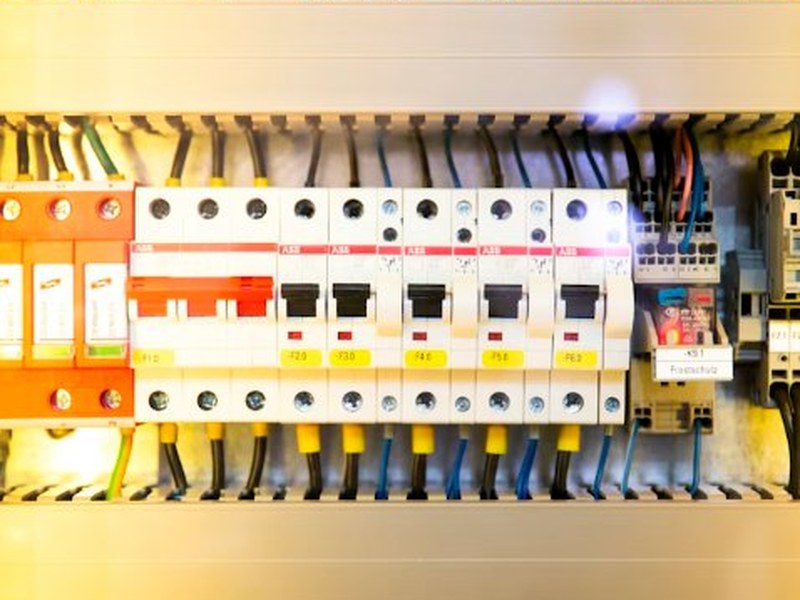
- I/O definition and panel design: We define every input and output, specify the hardware, and engineer the control panel that will house it.
- Offline programming and simulation: Code is written and tested in simulation before touching live equipment. This catches the majority of logic errors without production risk.
- Staged commissioning: We commission in stages — dry run (no product, no live utilities), wet run (utilities connected, product excluded), then live production with our engineers on-site.
- Documentation and training: Every project includes complete as-built documentation (I/O list, network drawing, PLC program backup, HMI backup) and operator training.
ROI: When Does Automation Pay for Itself?
The ROI calculation for automation depends on the application. The clearest cases are:
- High-frequency repetitive tasks: If a human is pressing a button 400 times a shift, that's a PLC task. Automation pays back quickly.
- Quality-critical processes: If a parameter being 5% off causes a batch rejection, PLC control eliminates that variation.
- Hazardous environments: Removing personnel from dangerous areas has both safety and cost implications.
- Labour-constrained operations: If you can't find enough qualified operators, automation reduces the headcount required.
Projects with clear ROI drivers typically pay back in 12–36 months. Projects driven primarily by efficiency improvements often take longer but deliver compounding value as the system matures.
Is Your Facility Ready to Automate?
The biggest predictor of automation project success isn't the technology — it's the process discipline of the operation. If a process is chaotic, inconsistent, or poorly documented, automating it locks in the chaos at machine speed.
Before committing to a full automation implementation, we recommend:
- Documenting the current process in detail — including all the exceptions and workarounds
- Identifying the top 3 causes of downtime or quality escapes
- Engaging your maintenance team early — they'll live with the system after launch
- Starting with a well-defined, bounded scope rather than trying to automate everything at once
Ready to discuss what automation could do for your facility? Contact us for a free consultation. We serve manufacturers in Surrey, Delta, Langley, Burnaby, Vancouver, Coquitlam, New Westminster, Richmond, and Abbotsford.